Blog
Barking at Thunder
After days of sun and blue skies and high, muggy temperatures, the clouds closed in, the sky darkened and the rain came. It was a relief. My morning routine is to get up early and sit outside before the sun starts to bake so that I can gather my thoughts for the day. During a recent storm which began in the night, I sat under the shelter of a side porch to watch the rain fall. My 15-pound, very smart, very fast Australian labradoodle Amie sat beside me.
As the sky darkened further and the rain fell harder, the thunder began, preceding and followed by lightning. At each roll of thunder, Amie leapt off the chair and ran into the yard barking fiercely at the thunder. She returned wet and satisfied when the sound abated and settled her soggy self back next to me. A few moments later, the thunder roared again louder and closer. Amie leapt to her feet and sprinted into the yard racing towards the river and the assaulting sound, barking at full volume.

“Don’t mess with me!” she seemed to be saying. “I’m not afraid! This is my home!” When the thunder retreated and the lightning blinked in the distance, Amie returned again soaked and settled beside me. After a third foray and defense against the thunder, I decided it was time to retreat inside. Despite her brave response and my enjoyment watching her and the storm, I take lightning seriously and decided the spectacle of a brilliant summer storm wasn’t worth the risk close-up. We watched the rest from the house with Amie at her post by the window and my morning thoughts unspooling on the sofa inside.
Barking at Thunder seems an apt description for our response to danger and the unexpected these days. My brave dog has no idea where the sound comes from, what it represents or how little damage thunder itself can do. Likely she doesn’t even see or register the lightning which is the danger. More to the point, she has no idea how irrelevant barking at the noise is, but her instinct is to protect and defend. The sound is fierce, even awe-inspiring so she responds in the way she knows.
The response to fear can often be as ineffectual as barking at thunder. I will resist taking this metaphor any further and leave it for readers to expand any wisdom or relevance it may have. I end with facts and advice on the literal example, not the metaphor, from the National Weather Service.
Happy summer…or winter depending on your hemisphere!
According to the National Weather Service:
Thunder is the sound caused by a nearby flash of lightning and can be heard for a distance of only about 10 miles from the lightning strike. The sound of thunder should serve as a warning to anyone outside that they are within striking distance of the storm and need to get to a safe place immediately!
Thunder is created when lightning passes through the air. The lightning discharge heats the air rapidly and causes it to expand. The temperature of the air in the lightning channel may reach as high as 50,000 degrees Fahrenheit, 5 times hotter than the surface of the sun. Immediately after the flash, the air cools and contracts quickly. This rapid expansion and contraction creates the sound wave that we hear as thunder.
Although a lightning discharge usually strikes just one spot on the ground, it travels many miles through the air. When you listen to thunder, you’ll first hear the thunder created by that portion of the lightning channel that is nearest you. As you continue to listen, you’ll hear the sound created from the portions of the channel farther and farther away. Typically, a sharp crack or click will indicate that the lightning channel passed nearby. If the thunder sounds more like a rumble, the lightning was at least several miles away. The loud boom that you sometimes hear is created by the main lightning channel as it reaches the ground.
Since you see lightning immediately and it takes the sound of thunder about 5 seconds to travel a mile, you can calculate the distance between you and the lightning. If you count the number of seconds between the flash of lightning and the sound of thunder, and then divide by 5, you’ll get the distance in miles to the lightning: 5 seconds = 1 mile, 15 seconds = 3 miles, 0 seconds = very close.
Keep in mind that you should be in a safe place while counting. Remember, if you can hear thunder, chances are that you’re within striking distance of the storm. You don’t want to get struck by the next flash of lightning.
Join me on Substack

Eyes On Pluto
With fraught political climates on the ground in many countries—at least 64 countries face elections this year with democracies in the balance—and with discourse often less than inspiring, I find myself looking up and into the clouds and the sky above for an uncluttered view. That instinct was further encouraged by a book I recently read and note in the Books to Check Out section of this Substack—David Ignatius’ Phantom Orbit. Even before reading this novel, I was recalling a major event in July nine years ago when the New Horizons spacecraft built by Johns Hopkins University’s Advanced Physics Lab gathered data and reported back from Pluto.
As a Hopkins trustee, I was privileged to watch the encounter along with others at the Advanced Physics Lab when the spacecraft reported from its Pluto orbit. “We’re in lock with telemetry with the spacecraft.” A cheer erupted! I re-publish here the story of the event which I still find stirring. The precision of calculations is astonishing, the vision expansive, and the cooperative effort and possibilities for the future inspiring.
Space is considerably more crowded nine years later and much has transpired. Space remains an open territory though one that we must hope doesn’t become clogged with earthbound conflicts and competitions.
EYES ON PLUTO…“WE DID IT!”
By Joanne Leedom-Ackerman | July 15, 2015
Headlines from earth yesterday heralded the Iranian Nuclear Deal, but some of us were looking skyward. On a small green campus tucked into suburban Maryland at the Johns Hopkins University Applied Physics Lab scientists, engineers, media, friends, family, faculty and board of Johns Hopkins University awaited the report back from Pluto. The New Horizons spacecraft, built by Hopkins APL engineers and scientists, had arrived at the outer planet three billion miles away after a nine and a half year journey. That evening the spacecraft was reporting in after 22 hours of silence while it gathered extensive data as it passed within 7750 miles of Pluto.
The spacecraft, which had been built in a record four years at APL, had traveled at a rate of a million miles/day (between 31,000-46,000mph depending on its orbit). The evening before it had started downloading data and taking pictures in a rapid collection of scientific information. It couldn’t do that job and call home at the same time so its progenitors waited anxiously at Mission Control, aware that any number of unpredictable events like a pebble size bit of detritus colliding could disrupt and destroy the mission.
“Stand by for telemetry….” Mission Operations Manager (MOM) Alice Bowman alerted. At 8:52:37pm—right on time—New Horizons called home. “We’re in lock with telemetry with the spacecraft,” she affirmed as one by one the systems managers reported: “MOM, propulsion is nominal…MOM, thermal is nominal…MOM, power is nominal…” Nominal meant normal. MOM meant Alice. The conclusion: “We have a healthy spacecraft and we’re outbound for Pluto!” The room at Mission Control and in the auditorium nearby burst into cheers and tears and gave a standing ovation. It was a remarkable moment and extraordinary achievement.
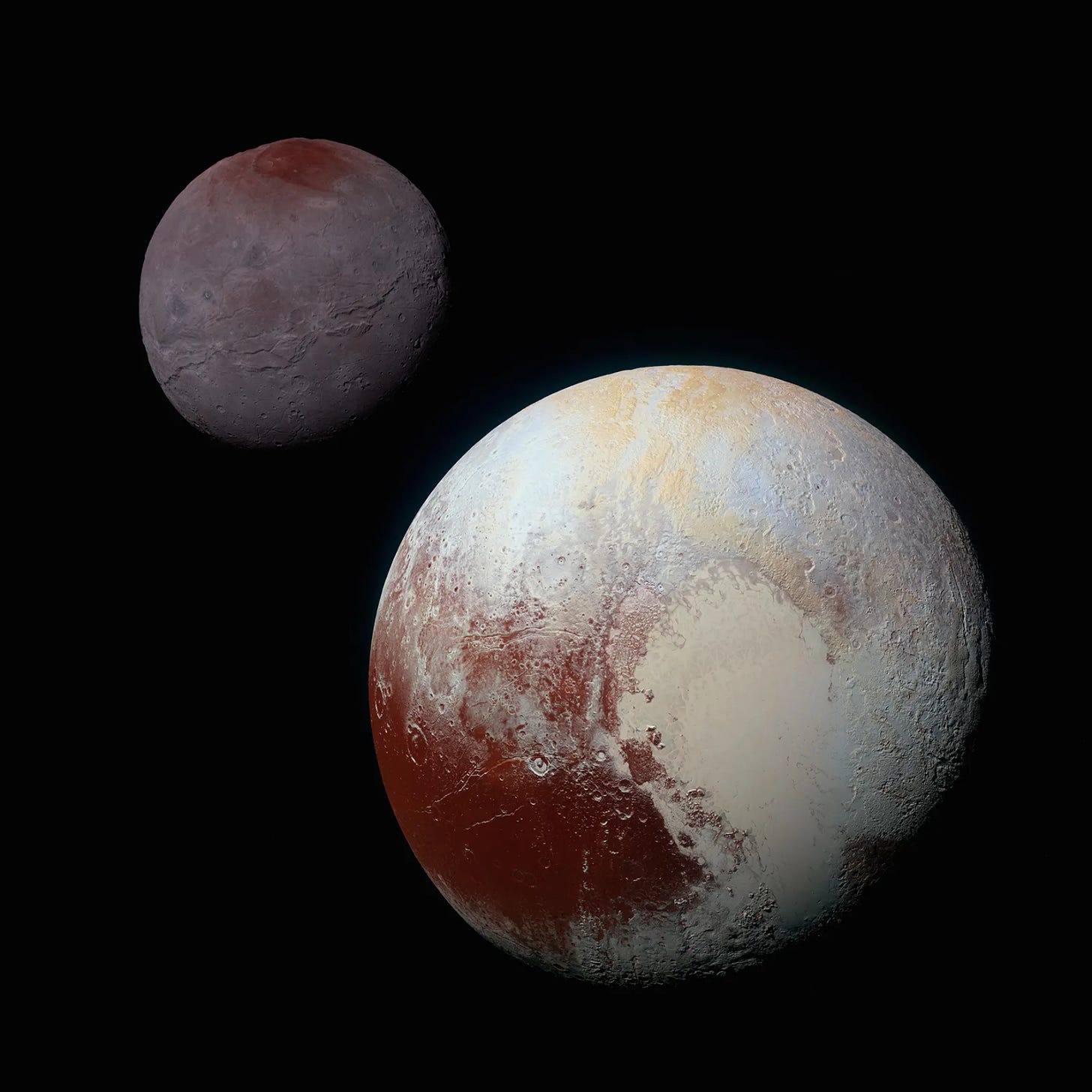
This composite of enhanced color images of Pluto (lower right) and Charon (upper left), was taken by NASA’s New Horizons spacecraft as it passed through the Pluto system on July 14, 2015.
The mission had proceeded like clockwork. It had been a team effort over a decade and a half, occupying 2500 people. The very best scientists and engineers built the space craft, designed its scientific mission (including the first student-designed project on a NASA mission), programmed its course. The trajectory included an important scientific data-gathering pass of Jupiter, where the spacecraft received a needed gravity assist which sent it hurling on its way into deep space.
New Horizons arrived at the closest approach to the planet just 72 seconds early. That precision over nine years and three billion miles was almost impossible to comprehend except to the scientists and engineers who understood that precision was essential to accomplish the task. Even a small margin of error projected over that amount of time and space could be disastrous.
The mission exemplified a remarkable achievement of teamwork and partnerships among NASA, universities, and the U.S. Department of Energy which supplied the plutonium power source. The nuclear power it provided will allow the spacecraft to operate until 2030. The total power draw for the Pluto encounter was only 202 watts (about three and a half light bulbs). Each transmission draws only 28 watts (enough to power two small night lights.) Reception of these transmissions relies on super giant receivers—the Deep Space Network. There are only three in the world large enough—one in Madrid, Spain, one in Pasadena, CA in the US and one outside Canberra, Australia. The placement of them means that data can be received at any time as the earth spins on its axis. Last night’s transmissions were broadcast from Pluto four and a half hours before they were received, traveling at the speed of light and sent via the giant antenna dish in Madrid.
Alan Stern, the head of the New Horizons Mission and NASA’s chief investigator, told the gathering: “We did it! One small step for New Horizons, one giant leap for mankind.”
The audience included students who had been born almost ten years before on the day of the New Horizons launch. An elementary school boy asked, “Does this make Pluto a planet?” Fran Bagenal, NASA team leader for plasma investigations on the Mission, answered, “Yes! Of course Pluto is a planet!”
The Pluto mission began as a barroom bet by Alan Stern to prove Pluto was not just a dwarf planet but a full planet. The exploration was affirmed as a top priority by the National Academy of Science. In the audience last night were the grown children of Claude Tombaugh, the astronomer who originally discovered Pluto. Eighty-five years earlier their father told his senior astronomer, “I think I have found your planet X.”
Fifty years before to the day—July 14—humans first explored Mars with NASA’s Mariner 4. John Casani, special assistant to the director at NASA’s Jet Propulsion Laboratory (JPL) and one of the early engineers in the space program noted, “People developing spacecraft today know what they are doing. We didn’t know what we were doing. Back then the shoulders we were standing on were too narrow and our shoes were too big. We had only the technology for guided missiles.”
The scientists and engineers had to figure out, among other concepts, 3-axis stabilization. “Innovation was the key to making things work,” Dr. Casani said. “There was no book on 3-axis stabilization. We were all only a couple of years out of graduate school. We weren’t experienced enough to know that what they were asking us to do couldn’t be done.”
“You couldn’t go to the library and ask for a book,” added Norm Haynes, who was the trajectory engineer for the Mariner 4 Mission and also spent his career at NASA’s JPL. “There were no textbooks on how to build a spacecraft.”
There were no computers on board the first spacecrafts either. In 1962 the computer had only a 65,000-word vocabulary as opposed to the multiple gigabytes of memory today. The first computer was aboard Mariner 4 which delivered 22 pictures of Mars, each taking ten hours to send back. It took 60 hours to go to the Moon, 6,000 hours to go to Mars and now the New Horizons spacecraft can endure a nine and a half year journey to Pluto and still arrive in tact. The per mile cost of New Horizon was 25 cents/mile; the per mile cost of Columbus was $3000/mile and the per mile cost of Magellan was $5000/mile. On Mariner 4 in 1965 the spacecraft transmitted information at 8 1/3 bits / second; New Horizon transmits at 1000 bits/second and it is 60 times further away.
The scientists and engineers said the key to success was the willingness to imagine, to innovate and to be willing to fail. Considerable failures preceded this achievement.
Why is the exploration of Pluto important? It opens up our view of what is possible, of the universe and perhaps even of ourselves, suggesting larger horizons physical and metaphysical. It demonstrates the possibilities of human potential—of imagination and ingenuity empowered by cooperation, teamwork and a large goal. From a scientific point of view, from the point of view of NASA which has to secure the funding, it provides knowledge about the universe where we live and the universe beyond.
The data that will be gathered on the New Horizons’ close approach to Pluto is about 100 times more than can transmit before the spacecraft flies away. It will take 16 months to send all the scientific information home.
“We explore because we are human, but we want to know,” said noted physicist Stephen Hawking in a call-in message to the gathering.
If the next stage is funded, the New Horizons spacecraft will go off to explore the outer reaches of the Kuiper Belt, letting us know what lies beyond Pluto in the further reaches of space.
The spacecraft was built to last. Its power will endure until 2030, then it will not be sufficient to keep the instruments warm enough to operate, and the craft will drift into deep space. By 2030, the equipment on the spacecraft will be 40 years old and the innovations that will have developed by then we can now barely imagine.
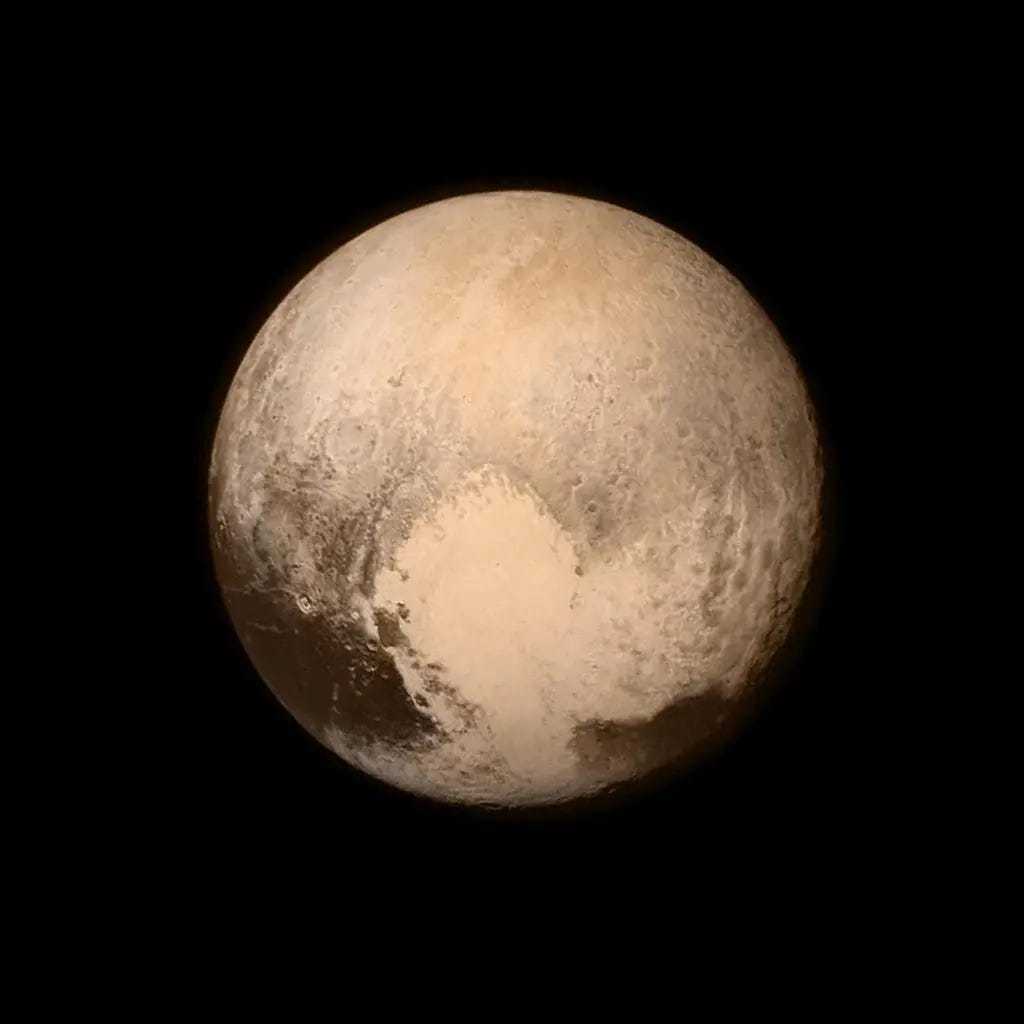
Credits: NASA/Johns Hopkins University Applied Physics Laboratory/Southwest Research Institute
Join me on Substack
Calm Before and During the Storm
Poised on the threshold of summer, of university protests and disrupted graduations, of US political conventions in July and August, of threatening weather with tornados and hurricanes churning on both US coasts and in the middle of the country, I pause in a patch of early morning sun to savor and seal a moment of calm.
Though I won’t be at the political conventions—may even be out of the country for one of them—and will hopefully miss the worst of summer weather, storms appear on the horizon, and it does no harm to prepare by identifying and fixing one’s North Star.
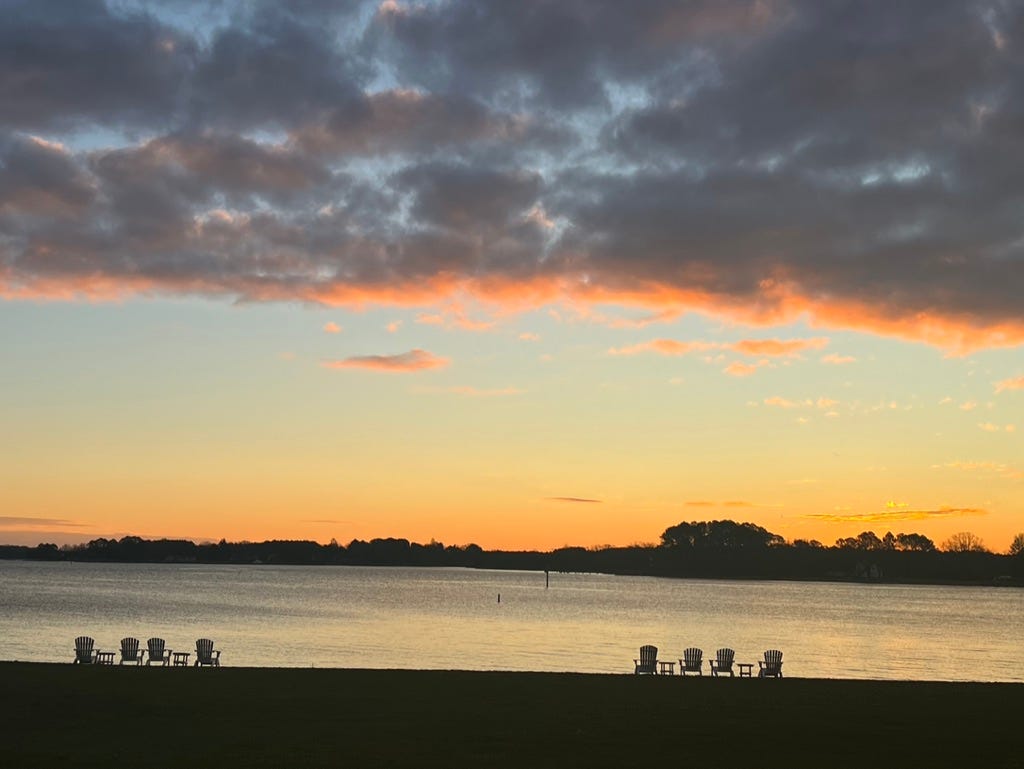
Photo credit: Joanne Leedom-Ackerman
Before the arguments begin or untruths unfurl, or provocations proliferate among the citizenry or even in one’s own family during the US election season, I pause in gratitude that we are allowed to disagree and even protest nonviolently. I am grateful when journalists I know and those I read and listen to work to uncover facts and report in an unbiased fashion. These, however, are not my North Star. I rely instead on a more transcendent light, lodged deeper in a universe that moves towards harmony. I see evidence of this harmony in people caring for each other in the smallest details, in strangers who regularly hoisted my heavy suitcase filled with books and papers into the overhead for me as I traveled on a book tour, in the Uber driver originally from Uzbekistan who stopped en route in NYC to buy me a bottle of water. Small kindnesses we offer each other are the fabric of our citizenry and the evidence that we can be and continue to evolve into a more perfect union.
In the most intractable conflicts between nations, it is the citizens who inevitably must find peace with each other, and perhaps it is with the citizens that the seeds of peace can begin to grow even when politicians are deadlocked. I recall stories from the Balkans War in a memoir Worlds Apart by Ambassador Swanee Hunt. I quote here from the review I wrote in The Christian Science Monitor a decade ago, along with a link to the full article.
The city is surrounded. Shelling rains down on the population. Sniper fire, bombs, mortars erupt from all directions. There are no safe havens for civilians; dozens are killed each day. The international community meets, protests, debates what should be done. Powerful players like Russia obstruct action. Sanctions are tightened, but it is citizens who suffer most. Outside nations are willing to offer humanitarian aid, but are conflicted about arming the opposition. The UN organizes peacekeeping forces, but the mandate and rules of engagement are unclear. The siege and the deaths continue … for years.
This description could be from today’s headlines in Syria, but instead it is the siege of Sarajevo in Bosnia 20 years ago. The paralysis of the international community to intervene and prevent the killings of citizens is still haunting.
In Worlds Apart, former Austrian Ambassador Swanee Hunt chronicles her years (1993-1997) on the inside and the outside of the corridors of war in Bosnia. As the US Ambassador located in Vienna, she sat at embassy dinners, met with European and US government officials, engaged in countless discussions of what should be done. She also used her position, both geographic and political, to visit with the citizens of Bosnia dozens of times in the country and to bring citizens outside the country to meet with each other….
I hope you’ll read the full review linked above and also the book.
And so I will continue to pause in the mornings and savor the light and the promise and endeavor to add my own small and large kindnesses along the way.
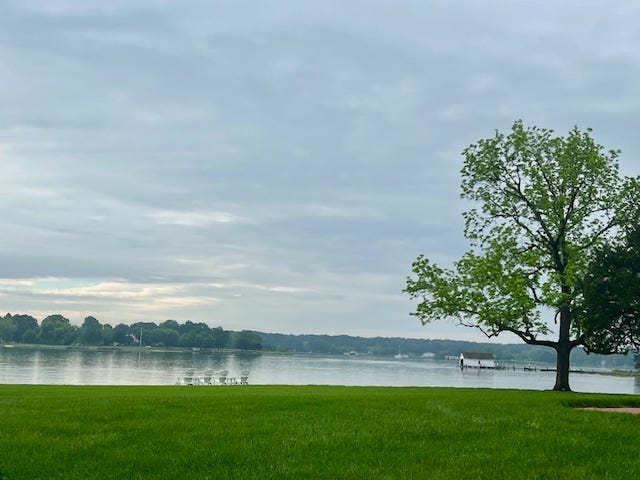
Photo credit: Joanne Leedom-Ackerman
Join me on Substack
Bridges Through Literature
In the early years of this century—2004-2007—I was elected the International Secretary of PEN International, a position at the time responsible for overseeing the running of the day-to-day operations of the global organization, along with a small staff. (During my term we hired the first paid executive director.) PEN’s international organization includes four standing committees—the Peace Committee, the Writers in Prison Committee, the Translation and Linguistic Rights Committee and the Women Writers Committee.
Because I’d been Chair of the Writers in Prison Committee, which oversees the human rights activities of PEN and takes action in defense of writers in prison and at risk around the world, I understood this committee’s work and mandate. I understood the work and mandate of the Translation and Linguistic Rights Committee to defend minority languages and promote the translation of literature globally. And as one of the founding members of the Women Writers Committee which opened up representation by women in PEN and globally, I understood its mandate.
But the Peace Committee always seemed to me more ethereal and abstract. As writers we were not usually at the peace tables, though unfortunately at that time certain writers in the Balkans had helped foment the conflict. Besides passing resolutions for peace and hosting symposiums, what actions could the committee take? One idea of mine, which never did operationalize, was that writers on opposite sides of a conflict could read each other’s best work—not political or polemical work—but the best literature which deals with the human heart and aspirations.
What if Palestinian PEN chose one of the best writings by a Palestinian writer and Israeli PEN read and discussed it, and Israeli PEN suggested a book by one of its best writers and the Palestinian PEN members read and discussed it? Would that open corridors of thought and conversation?
I concede now the rather naive and utopian concept, but to move this utopian vision further into the clouds, what if the members of the two centers could meet and discuss the works as fellow writers! Well, not all dreams come true. Especially when formulated by someone outside of the conflict zone and insulated from the intense emotions and realities on the ground. I admit idealism is not always helpful.
But PEN is an organization of writers, not of politicians or military strategists. As writers we have the luxury and the responsibility to look deeper into the human spirit to find what binds us, to see bridges where others only see chasms.
At the height of the war in the Balkans in 1993, PEN International held its 60th global Congress in Santiago de Compostela, Spain, where the presidency of the organization passed hands from Hungarian novelist György Konrád to British playwright Ronald Harwood. The Balkans War was in full conflict then. Salman Rushdie visited that Congress. At that Congress I was elected Chair of PEN International’s Writers in Prison Committee which brought me into the center of discussions. At the Congress a new Bosnian Center whose members were Serb, Croat and Bosnian was unanimously welcomed as was an ex-Yugoslav Center for writers who no longer lived in the region.
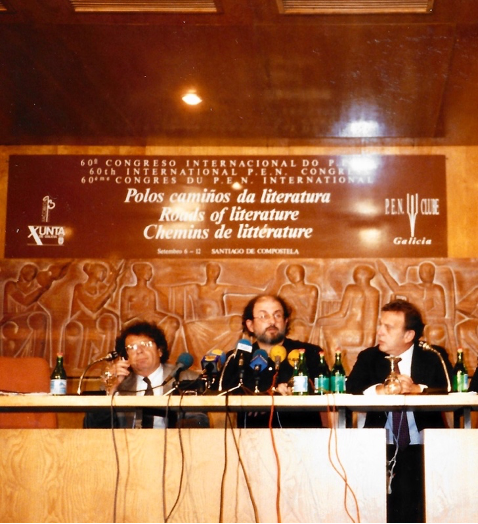
International PEN 60th Congress Assembly of Delegates in Santiago de Compostela 1993. Left to right: György Konrád, Salman Rushdie, Ronald Harwood
The 60th PEN Congress was a watershed of sorts. Konrád’s address at the opening session went a way in bringing the delegates together. “What we can do is to try and ensure the survival of the spirit of dialogue between the writers of the communities that now confront each other….International PEN stands for universalism and individualism, an insistence on a conversation between literatures that rises above differences of race, nation, creed or class, for that lack of prejudice which allows writers to read writers without identifying them with a community…
“Ours is an optimistic hypothesis: we believe that we can understand each other and that we can come to an understanding in many respects. The existence of communication between nations, and the operation of International PEN confirm this hypothesis…PEN defends the freedom of writers all over the world, that is its essence.”
Ronald Harwood added in his acceptance for the presidency: “The world seems to be fragmenting; PEN must never fragment. We have to do what we can do for our fellow-writers and for literature as a united body; otherwise we perish. And our differences are our strength: our different languages, cultures and literatures are our strength. Nothing gives me more pride than to be part of this organization when I come to a Congress and see the diversity of human beings here and know that we all have at least one thing in common. We write…We are not the United Nations…We cannot solve the world’s problems…Each time we go beyond our remit, which is literature and language and the freedom of expression of writers, we diminish our integrity and damage our credibility…We don’t represent governments; we represent ourselves and our Centers…We are here to serve writers and writing and literature, and that is enough…And let us remember and take pleasure in this: that when the words International PEN are uttered they become synonymous with the freedom from fear.”
These words echo today. Linked here is the fuller account of the 60th Congress, of Rushdie’s visit and of PEN’s wrestling with the issues of the time. In PEN Journeys: Memoir of Literature on the Line is an expanded narrative of at least a third of PEN’s century which I’ve had the privilege of participating in—of its history, of writers’ wisdom, of failed idealism and also achieved visions.
Join me on Substack
Spring Showers…Ideas Blooming…Book Tours in the Rain
Four out of the first six book events for my new novel The Far Side of the Desert occurred in the rain with downpours in two cities. Such is the peril of a March pub date, but better than snowstorms in January. A pleasant surprise was how many friends and new readers showed up anyway. A cozy bookstore on a rainy day or evening has its own appeal.

Still on the road, I’m grateful to all those who value books and ideas and friendship and particularly the independent bookstores that host the gatherings. However one comes into contact with ideas and with the experience of others, horizons open and thought expands, both for the writer and the reader. Expanding thought and perceived experience is how we grow.
We are privileged to be able to share books and ideas, a freedom of expression and assembly not to be taken for granted. Ideas are the food of healthy societies, and books are one of the vehicles for these. A tour across the U.S. highlights this privilege which shrinks with censorship and almost disappears if the writer is put behind bars as is the case in too many countries.
Each month in my Substack I feature a writer at risk who is not as fortunate but is targeted by governments threatened by conflicting ideas.
May the power of ideas and imagination and the freedom to write endure and expand.
Join me on Substack
The Far Side of the Desert
July, 2007
A Moorish king and queen bobbed momentarily above Samantha Waters’s scrambled eggs as if waiting to be fed. Outside the second-floor windows of the Hostal dos Reis Católicos, 12-foot puppets of kings and queens and devils and saints peered into the dining room then lurched away toward the square. Samantha leaned over the balustrade and filmed the festivities on the plaza below.
“Let’s go, Monte,” she urged her sister who was hunched over the wooden table with a plate of pancakes. “We can get coffee on the plaza.”
Outside, the smell of coffee and fresh almond cakes rose from pushcarts as pilgrims hurried past shaking tambourines, beating drums and filling the morning air with sound. Somewhere bagpipes played. The sun was already baking the cobblestones in the square where tables and chairs had been set up.
“It’s too crowded,” Monte complained as they merged with a stream of dancers and musicians. “This is a security nightmare!”
“It’s a festival!” Samantha spotted an empty table and tossed her black straw hat over the heads of other spectators to claim it. They’d arrived late last night, she from London and Monte from the U.S. Embassy in Cairo. At breakfast they’d read the guidebook which explained how a monk in the 9th century had discovered the body of the Apostle in a vault in the King and Queen’s home village. The village had been celebrating its destiny ever since….”
So begins my new novel The Far Side of the Desert which comes out March 5 and can be ordered now. It is the story of a diplomatic family, including two sisters and a brother, pulled into the nexus of a global plot when one of the sisters is kidnapped at a festival. No one asks for ransom or contacts the family about her whereabouts or why she was taken. Moving from Spain to Cairo to Washington to London to Morocco to Gibraltar, The Far Side of the Desert is a family drama and a political thriller that explores the links of terrorism, crime, and financial manipulation and the grace that ultimately foils destruction.
I hope you’ll read and be engaged by the story, the characters, and the themes. If you are, I hope you’ll tell friends, write a review, make a little noise.

Like my novel Burning Distance which published last year, The Far Side of the Desert is a story written and re-written over many years.
Shared here is the backstory from the Author’s Note:
I first visited Santiago de Compostela, Spain—the opening scene in The Far Side of the Desert—in 1993 as a delegate to PEN International’s 60th Congress. The PEN Congress coincided with the Festival of St. James and the Camino de Santiago where tourists and pilgrims gathered on the plaza in front of the massive Baroque and Romanesque cathedral. The PEN Congress was an entirely separate event, but the festivities overlapped in the square.
Salman Rushdie made a surprise visit to the Congress, one of his first since the fatwa had been issued against him. At that Congress I was elected the Chair of PEN International’s Writers in Prison Committee, the division of PEN that spearheads PEN’s human rights work on behalf of persecuted writers worldwide so I was one of a small group who greeted and shared dinner with Rushdie. I mention these events because it was there I began contemplating what it would be like if one had to disappear or was disappeared, either by choice or coercion. That question is central to the opening of The Far Side of the Desert. What happens when all the familiar props of life are taken away?
There are many events, much research and intertwining threads that develop in The Far Side of the Desert, but the seed of imagination began in Santiago de Compostela and at the end of the Camino on the rugged cliffs of Galicia facing west over the Atlantic. It is here the ancient Romans thought the world ended, a spot they called the Cape of Death because the sun died there and because ships wrecked on the rocks that jutted out into the sea. The Romans saw nothing westward and could imagine nothing but terrors so they declared Non plus Ultra: There is nothing beyond.
Imagining what is beyond, discovering what holds and what falls away is the journey of the two sisters Monte and Samantha Waters who are from an American diplomatic family. The outer frame of the story includes drug and arms trafficking, money laundering, and financial manipulation—a membrane of crime that smothers large parts of the globe. But the core is the characters and the journeys of their hearts and minds.
Join me on Substack
One Voice…One Thought…One Oyster Shell at a Time
Sitting in an easy chair with my laptop desk and computer, I look out over the river on this winter’s day—frozen ground, chunks of ice littering the lawn, an American flag fluttering out the window and four white Adirondack chairs by the water ready for occupants in the spring. The land and the river edged with ice abide as we wait for leaves to fill in the skeletal trees, though the magnolia remains in leafy bloom though without flowers.

Outside this quiet winter scene, the world continues to roil both at home and abroad. In the US, a presidential election is moving nearer as the first primaries have gotten underway, though certain campaigns have been going on relentlessly as if the campaigning never stopped between elections. It is an exhausting dance of our democracy, and this year is especially fraught. America’s politics this time round feels more like that of some other country’s…maybe Italy’s?—though our system assures whoever ascends to power will likely be ensconced for four years. Our door does not revolve so easily to usher leaders in and out.
One friend distressed by this year’s election decamped to New Hampshire, scene of the second primary, to do what I’m not sure, but to be there and work and participate in this every-four-year process of choosing. That these early choices take place in even colder weather with frozen hard ground and the buds of spring even further away perhaps pays homage to the rugged winters that greeted our earliest forefathers.
As I sit comfortably in my chair, I contemplate what role most of us not directly connected have, both at home and in conflicts abroad. Is it enough to watch from afar, to stay informed? For what purpose and what action?
I was always taught that my thought and my voice mattered. I was responsible for how I thought even if it wasn’t recorded or couldn’t be directly acted upon. How I thought was my responsibility to add beneficence to the global stream of thought. Offering as wise and pure a contribution as I could was like dropping a small purification tablet into the much larger pool. Just as one small tablet can purify 25 gallons of water, a single thought can uplift a community.
I live parttime on the Eastern Shore of Maryland where phalanxes of citizens work to keep the rivers clean so they and their children can rely on the rivers for fish and crabs and their children can swim in the waters, but it takes work by the citizenry. One of the facilitators helping purify the waters are the oysters that live in the rivers. A single oyster can filter 50 gallons of water a day, straining out the impurities. In the 1600s when John Smith first sailed down these rivers, the waters of the Chesapeake renewed with fresh water every two or three days. Now it is more like every 600 days, according to the Shore Rivers project which works to clean up and keep clean the rivers of the Chesapeake.

One oyster purifying 50 gallons of water each day! It is a remarkable dynamic. A successful project has been launched to repopulate the rivers with oysters, just one of many methods to clean the rivers. The effort is paying off.
At the risk of stretching the comparison, it is interesting to consider how one’s individual clear, honest, caring, selfless thought might purify a community of thought, dissolving and straining out anger, recrimination, untruths, vitriol, excessive grievances…whatever the issues of polity might be.
In the river I look out on, oysters have been growing on the bottom and are purifying the water daily. I carry hope that we citizens too can clean up the muck in the discourse and fabric of our individual lives, community, and globe one thought, one oyster shell at a time.
Join me on Substack
Sunrise and a Wish
Sometimes I lose myself in the sunrise. I watch the earth’s slow motion as the sun creeps above the horizon, first as a streak of red light in the dark sky expanding into yellow-orange-pink and then the sun itself peeking above the horizon and breaking into a full orbed golden disc lighting up the landscape.

Knowing this same movement is witnessed around the world confers a kind of unity for the earth. When conflicts seem fraught and discourse harsh in politics and among citizens, when solutions appear elusive, I watch the sun rise and take comfort that it will do so day after day no matter what we on earth are doing. It symbolizes a larger force and deeper meanings we often miss, absorbed as we are in our own day to day.

Though I may not grasp the fuller meaning, I know it is there. I recognize the qualities that enable me to glimpse the outlines. An essential is gratitude. The season of Thanksgiving in the U.S. and a few other countries, of the holidays which celebrate the arrival of wisdom and wise men and women, be it Christmas, Hannukah, Eid, Kwanzaa, Diwali. Often these are celebrated with lights strung up to illumine the darker months. Light has long been the metaphor for wisdom as darkness flees before it because it can’t exist when light is present. Darkness is only the absence of light.

As we head into this season, I hope to do so with a listening thought for the wisdom waiting and a regarding eye to see pathways that may yet appear and connect. Wishing for peace seems too facile, but perhaps wishing for an understanding heart and the way to defuse violence and meanness of spirit. Acknowledging that conflict may continue among people but seeking ways to take the violence out of it and to find ways to exist together, that seems more obtainable. May we stand in wonder as the sun rises wherever we are and may our thoughts let in the light and open outward.

In an Unspeakable Time…Thanksgiving…Gratitude?
It is lunchtime on a blue sky day in Washington, DC. Outside on the restaurant patio where I’ve had breakfast and have been writing, patrons sit among red and pink flowers and flora tinged with autumn discussing the tangle of Washington politics—still no Speaker of the US House of Representatives at this writing a week ago—chaos in the Middle East after unspeakable brutalities and destruction, intensive fighting continuing in the Ukraine and the borders of Russia. There is a sense of the world pulling apart at the seams of international order.
We have felt stress and strain before, but for historic and emotional reasons, this period feels more acute. Yet the sun is shining, and the patterns of daily life remain uninterrupted for most Americans, including those in Washington, DC. The disruption is in our personal response and emotional reaction to the events at home and abroad.
When friends and acquaintances grow especially upset by political events, I sometimes quietly ask, “Did the President call you today?” Or “Did your Senator, House representative manage to reach you for advice?” No. Though our advice and feelings are often shared with anyone who will listen, in a democracy, our voice is usually heeded indirectly, at least on national and international matters.
We rely on our ability to think and feel freely to interpret events we have no direct role in shaping unless perhaps we’re in the media whose function is to inform so we citizens can react intelligently. We can write letters, text, phone, join peaceful demonstrations and let our views be known. We can join organizations, political and nonpolitical, contribute our work, wealth, and wisdom to effect change, but as a citizenry, our direct opinion is only sought every few years at the ballot box.
So how can we contribute to a more harmonious outcome in world affairs, or even local affairs utilizing our freedom to think and to speak? Tragedies often bring societies together to help each other and unite, but when societies define themselves in oppositional terms, unity and goodwill quickly dissipate and turn into a hardened will to dominate and prevail.
As a writer, words have been my medium, even if the reach is circumscribed. But as I’m watching alarming events and behaviors thousands of miles away in the Middle East and in Europe, words feel inadequate to resolve and to inspire.
The primary mandate in Article 1 of the United Nations Charter is “to maintain international peace and security and to that end to take effective collective measures for the prevention and removal of threats to the peace, and for the suppression of acts of aggression or other breaches of the peace.” Is this the goal, the light to be sought and followed? How can the individual citizen’s thought and actions contribute?
The only answers I have come to begin with one. Begin with each. Begin with the smallest, yet largest need to see the good, a good, and build from there. The risk of Pollyanna thinking is profound. I hear voices deride, but my hope is that here is the beginning of prayer which can link to a higher and benevolent Principle governing us all. Yet even as I write that, I hear the commentator this morning saying, “If politicians begin with ‘I hope…’ they have already lost. Hope is not a strategy.” So perhaps not hope, but determination to find and build upon that which words only represent—love, humanity, freedom.… Are those adequate words? What are the words? Or perhaps where is the thought? I sometimes wish I were a musician. I can almost hear the harmony in my head, but I don’t know how to render the notes….
Join me on Substack
On the Edge of the UN
The week of the United Nations General Assembly (UNGA) meeting is full of targeted and chaotic energy from around the world. I was there by chance last year with all the traffic snarls, blocked streets and crush of crowds, especially on the day the U.S. President was in town. I vowed to avoid that week forevermore.
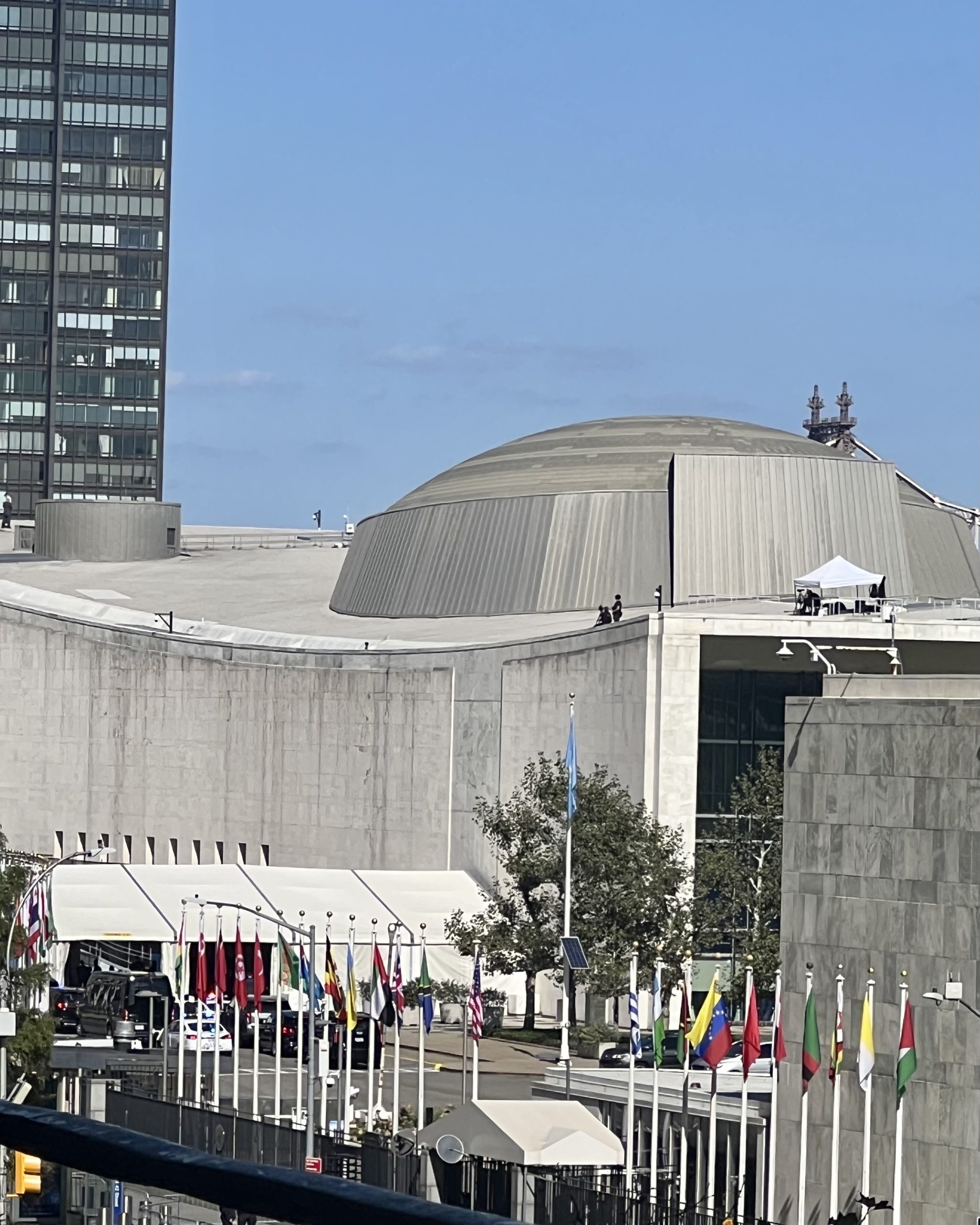
Flags of the United Nations during General Assembly week, September 2023.
But this year with a meeting I could only get on Monday and another on Friday and various events and meetings in between during mid-September, I called to book a hotel, only to find hotels were sold out and the price of the few available rooms had skyrocketed. Alas, I realized it was the week of the UNGA.
I finally managed to find a hotel not costing the price of a car down payment. With more experience, I scheduled meetings I could walk to, and, with the exception of the first day when torrents of rain doused the city, the weather cooperated with sunny fall days. New York bristled with the added energy of the United Nations General Assembly in town as delegates from around the world walked the streets in all the finery and dress from African, Asian, and Latin American countries.
The larger question is what was accomplished at the UN General Assembly. That remains to be seen at this writing, but there are a few hopeful signs. At the least there is something heartening about seeing representatives from the nations of the world come together in anticipation of getting along long enough to solve global problems affecting us all like climate, migration, and armed conflict.
For those of us born after World War Two—and that now includes most of the world’s population— there is a compelling desire to avoid such a conflagration again. Those who witnessed with optimism the fall of the Berlin Wall and a turn towards democratic government in Eastern Europe and around the world in the 1990s are now alarmed by the return of authoritarianism. Signs of stress on the international governing systems are mounting.
There continues to be a need beyond the United Nations for international forums where problems can be addressed and solutions crafted. In August I had the opportunity to visit one institution which keeps watch over a crucial pilar of free societies—the free press and its free flow of information. In late summer I visited Radio Free Europe/Radio Liberty (RFE/RL) whose mission is to promote democratic values and report accurate, uncensored news in countries where the press is threatened and disinformation abounds.
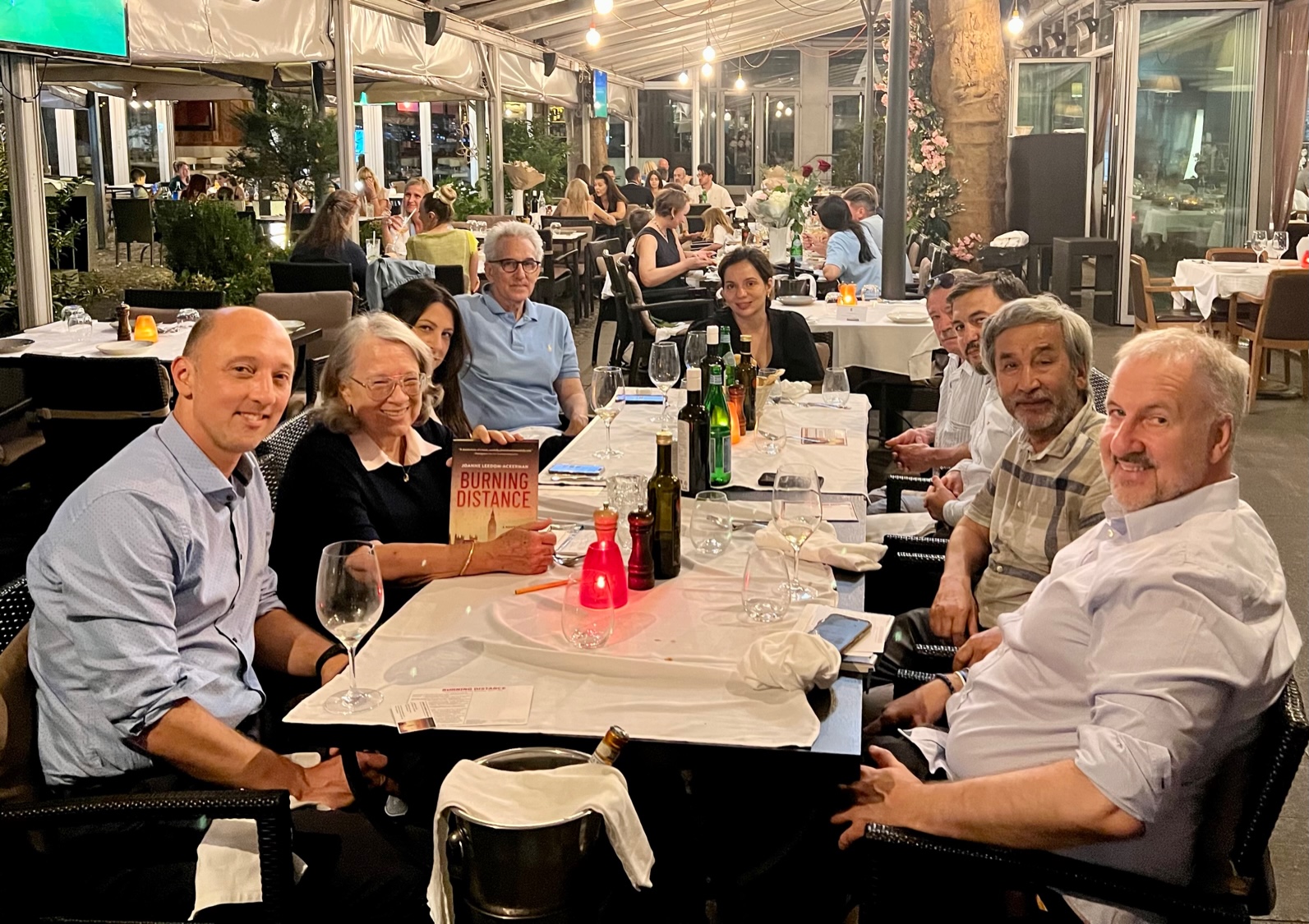
Dinner with journalists from Radio Free Europe/Radio Liberty in Prague, discussing writing, my novel Burning Distance and current affairs, August 2023.
Headquartered in Prague on a secure and sprawling campus, RFE/RL employs 700 journalists around the world to research, write and broadcast stories that uncover corruption and advocate for free societies and their institutions like independent judiciaries and free press. With large newsrooms and correspondents who report the news in 27 languages in 23 countries where a free press is banned or works under threat, RFE/RL is on the front lines.
As the newsrooms of traditional press shrink and the numbers of foreign correspondents dwindle, it was heartening to walk through the halls and newsrooms at RFE/RL and sit around a table with experienced journalists from Europe, the Middle East, and Latin America who have resources available to investigate and report critical stories. Logging a weekly audience of 40 million and 869 million yearly visits to its website and 15 billion annual video views, RFE/RL is one of the most comprehensive news operations in the world with 21 local bureaus and an additional 1300 freelancers and stringers plus two bureaus in the U.S.
Approximately 1500 hours of radio programming are also broadcast every week where listeners can tune in on shortwaves. RFE/RL has a network of partner organizations that rebroadcast across 11 time zones. However, in the current climate, rebroadcasting is prohibited on local outlets in Azerbaijan, Belarus, Iran, Pakistan, Turkmenistan, Tajikistan, and Uzbekistan, and journalists are under increasing threat and censorship. RFE/RL’s website has been blocked in Crimea, its broadcasts jammed; the website is blocked in Iran where the bureau was closed and banned from FM and the Internet in Azerbaijan, and the accreditation stripped from journalists in Tajikistan, Turkmenistan, and Uzbekistan.
Registered as a private, nonprofit corporation, RFE/RL is funded by a grant from the U.S. Congress through the United States Agency for Global Media (USAGM) as a private grantee. Major policy decisions are made by its independent Board of Directors, the majority of whom are career journalists and human rights specialists. To guarantee journalistic credibility, a “firewall” was part of the enabling legislation and prohibits interference by U.S. government officials, including USAGM’s Chief Executive Officer, with the objective of producing independent reporting of the news. Journalists and editors make the final decisions on what stories to cover and how they are covered, according to Jeffrey Gedmin, the interim CEO of RFE/RL.
Headquarters of Radio Free Europe/Radio Liberty in Prague, Czech Republic.
Recent RFE/RL stories include lengthy investigations into corrupt practices in Russia where it reaches Russian-speaking audiences and beyond via the Current Time digital and 24/7 television network. Other stories include reports on the cease fire between Azerbaijan and Armenia in Nagorno-Karabakh and Azerbaijan’s military operations in the region; Ukrainian infantry breaking though Russian defenses, including a live briefing of Russia’s invasion; Iranian deputies vote to toughen penalties for women flouting the dress code; Georgian President Mikheil Saakashvili’s trial in Tbilisi.
Join me on Substack