Archive for July 2019
PEN Journey 6: Freedom and Beyond…War on the Horizon
PEN International celebrates its Centenary in 2021. I’ve been active in PEN for more than 30 years in various positions and now as an International Vice President Emeritus. With memories stirring and file drawers of documents and correspondence bulging, I am a walking archive and have been asked by PEN International to write down memories. I hope this personal PEN journey is of some interest.
PEN members played key roles in the shifting landscape of Europe in the early 1990’s as the Berlin Wall fell, and the East moved closer to the West. Playwright and PEN member Vaclav Havel, who spent multiple stays in prison for his opposition and activism against the Communist regime, was elected President of Czechoslovakia in December, 1989. Czech writers Jiri Stransky and Jiri Grusa, both of whom spent time in jail under the Communists, later worked with Havel. Jiri Stransky became President of Czech PEN, and Jiri Grusa worked in the Ministry of Foreign Affairs and later was elected President of PEN International in 2003. Dissident Hungarian writer Arpad Goncz, whose name was on the program of the 55th PEN Congress as a member of the Hungarian delegation, was prevented from coming because on the day he was to depart, he was elected President of Hungary.
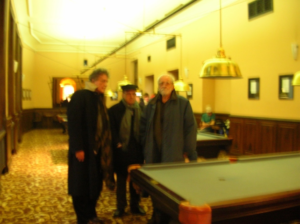
Czech PEN members playwright Tom Stoppard, Jiri Grusa (President of PEN International) and Jiri Stransky (Czech PEN President) at historic restaurant in Prague in 2005
At PEN’s 55th Congress in Madeira, Portugal May,1990, Hungarian novelist Gyorgy Konrad was elected President of International PEN after the unexpected death of President Rene Tavernier. According to the interim and past President Per Wastberg, Konrad had been “very active in the spiritual liberation not only of his own country, Hungary, but of Eastern and Central Europe.”
Konrad told the Assembly of Delegates, “It had been the spirit of human rights, which corresponded with the main interest of the freedom of the mind and of literature, which had been the motive force in recent events in Eastern Europe so that it had been the spirit, rather the physical force, which had caused the shifts in power.” [But] “liberated from the uneasy situation of the censorship of the one-party system, writers there were facing a new sort of danger, the danger of conflicts between nationalities spurred on by national chauvinism. If it was possible to find understanding between writers in that very disturbed part of Europe, maybe it would also be easier to find understanding between the governments and the peoples. Therefore the PEN Centers and their members could perhaps form the avantgarde of this understanding.”
The East German delegate noted it was “the writers, theatre people and artists of the GDR who had blown that trumpet and done a great deal to bring about the collapse [of the wall.] It was they who had called for a huge demonstration on 4th November, at which two million people had gone out onto the streets of East Berlin, demanding changes.” The GDR PEN Center had also “blown the trumpet much earlier when they had supported Vaclav Havel and demanded his release from prison, which, at that time—more than a year ago—had been a thing not without danger in the GDR,” he said.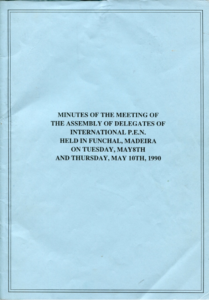
Yet the breaking up of the Communist regimes with their centralized authority was also leaving in the wake difficult conditions for many writers. Their publishers were closing, their livelihoods shrinking, and the West was taking over. “This did not mean that the writers of the GDR did not wholeheartedly go out onto the streets when they were called on to demonstrate for freedom of expression of writing, of thought and of travel,” the East German delegate said. But “now they had to take the harder road to freedom as Brecht had put it, with a proud bearing, even if they might lose in the process.”
The delegate from Poland saw two major problems ahead: “The first was political: the danger that the remnants of Stalinism might ally with the proponents of extreme right chauvinism. To overcome this danger it was necessary that the new democracies should be stabilized. The second problem was cultural: to find models for cultural life in their countries. They did have a very serious crisis in the domain of publication.”
Because of the collapse of currencies and income in these countries and the withdrawal of state support for arts and culture, it was increasingly difficult for the writers and PEN centers to pay their dues to International PEN and to find funds to travel to conferences and congresses. This situation also existed for many writers in Africa and Latin America where PEN had expanded its centers. In 1990 there were 96 PEN centers around the world.
At the Madeira Congress, PEN set up a Solidarity Fund to which countries with stronger currencies and income could contribute to assist their fellow members. The Assembly of Delegates formalized a procedure for a small, but broad-based committee to make these grant decisions. I was asked by the two American Centers to represent them on the committee, which also included representatives from Zimbabwe, Cote d’Ivoire, Polish, Soviet Russian, Canadian, English and French PEN Centers. Looking back, this new, more democratic process for dispersal of funds foreshadowed major change in PEN International’s own governing structure, change that was to come by the end of the decade.
“The collapse of the Berlin Wall…only provided an entry into the Promised Land…[but did not] overcome all the problems of coping with liberty for the first time,” reflected International Secretary Alexander Blokh to the Assembly of Delegates. “Now was the honeymoon period between East and West, but there was cause to fear that it might not last…While the trumpets of Jericho still sound in our ears, we should take steps to face up to these problems and iron out possible misunderstandings.” For this purpose PEN had held and was holding conferences in Vienna and Budapest with writers in the region.
The Congress discussion around the tectonic changes in Europe and the impact elsewhere occurred in idyllic Funchal, the capital city of Portugal’s Madeira archipelago, surrounded by hills, set on an expansive harbor with gardens and flowers everywhere. A cable car took delegates to the top of the island which offered sweeping views of the hillside neighborhoods and the town below. My specific memories are of bougainvilleas and the beauty of the setting, of the combined joy and worry of colleagues who used to emerge from the “Iron Curtain” to attend PEN gatherings, and now felt relief in their freedom but uncertainty about their lives and the future of their countries.
I remember specifically the establishment of the Solidarity Fund which operated in the 1990’s to help bridge the economic differences within PEN so that all centers could participate. PEN’s policy, though with exceptions, was that a center had to pay its dues in order to vote in the Assembly. Gilly Vincent, who later assisted the International PEN Foundation, remembers working late one winter’s night in the International PEN office when the doorbell rang. She went downstairs to find the Secretary of Polish PEN standing in the shadows at the front door. He had come to pay his Center’s dues in cash. She took the envelope and invited him in so that she could give him a receipt. He replied: “No. We carry no receipts” and vanished into the darkness, she recalls.
My memory of the Madeira Congress includes sharing meals with colleagues from Eastern Europe and with the Russian poet Yevgeny Yevtushenko, author of the famed Babi Yar who attended as a delegate from the new Soviet Russian PEN Center. [At the Vienna Congress a year later in November, 1991 the Soviet Russian PEN Center got approval to change its name to Russian PEN after the August coup where the Center had issued a statement “true to the best traditions of PEN”.] Yevtushenko, dressed as I recall in rather flamboyant clothes—all white suits (or were they all red or plaid?) commanded attention wherever he went. In the Assembly he spoke in support of a new Belarusian Center which he said would symbolize the democratization of the Soviet Union. He said its members would be helpful in the common fight on behalf of persecuted writers. He spoke in support of the Kurdish Writers Abroad Center changing its name to the Kurdish Center so that Kurdish Writers in Turkey wouldn’t be accused of “separatism” for joining it. And he supported PEN holding a conference in Alexandria, Egypt, where he said PEN must do everything possible to help Salman Rushdie and must ask Arab colleagues in Alexandria for support.
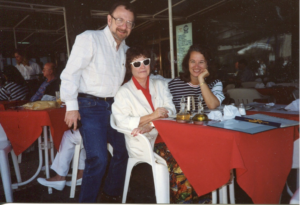
Richard Bray (PEN USA West Executive Director ), Carolyn See (PEN USA West President), and Joanne Leedom-Ackerman at the 55th PEN Congress in Madeira, Portugal
At the Writers in Prison Committee meetings and at the Assembly, PEN delegates also focused on the continuing crackdown in China, on the persecution of writers, editors and publishers in Turkey, Myanmar, Vietnam, Sudan, Cuba, and El Salvador. They protested the house arrest of the renowned novelist Pramoedya Ananta Toer in Indonesia. In May, 1990 PEN recorded 381 cases of writers in prison or banned. In spite of the changes in Eastern Europe, the numbers of persecuted writers had not declined worldwide, and there were still some cases in Central and Eastern Europe. PEN resolved to act in all these areas, but the seismic shift in the political landscape of Europe held the focus for the 55th Congress whose theme for the literary sessions was Language and Literatures: Unity and Diversity.
The breakdown of the Communist states was already leading to heightened nationalism, in no place more acutely than in the Republic of Yugoslavia. While most PEN members defended the move towards freer and more tolerant societies, there were some who espoused the nationalistic sentiments that led to the war which eventually broke out in the Balkans. A few took leadership roles in that conflict and separated from PEN which had centers in the former Yugoslav republics—Serbian PEN, Croatian PEN, and Slovene PEN. Only Slovene PEN attended the Madeira Congress. Slovene PEN had long been the annual host for PEN’s Peace Committee which met in Bled, Slovenia, an idyllic town on a lake where it was difficult to imagine war.
But war was on the horizon in the Balkans. What no one anticipated was that war was also on the horizon in the Middle East for in less than three months after the Madeira Congress, Iraq invaded Kuwait. By January, 1991 America and 39 other nations were at war with Iraq. The upcoming PEN Congress in Delphi, Greece had to be cancelled; the conference in Alexandria had already been cancelled at the Madeira Congress. Two months later, in March 1991 the first shots were fired in the Balkans in a war that would last four years.
Next Installment: PEN in Times of War and Women on the Move
PEN Journey 5: PEN in London, Early 1990’s
PEN International celebrates its Centenary in 2021. I’ve been active in PEN for more than 30 years in various positions and now as an International Vice President Emeritus. With memories stirring and file drawers of documents and correspondence bulging, I am a walking archive and have been asked by PEN International to write down memories. I hope this personal PEN journey might be of interest.
I moved to London where International PEN is headquartered in January 1990 from Los Angeles. I came with my husband and my 9 and 11-year old sons who rarely wore long sleeves, let alone coats or jackets. A few weeks into our resettlement, London spun in its first major tornado of the decade with hail and winds whipping at hurricane force and cars and trees toppled and a few rooftops airborne. The weather was highly unusual for London. Our family, who was still in temporary housing, took the unwelcome weather as a welcome of sorts, signaling that we might just be in for an adventure. Did you see that roof flying…!
There were still complaints: only four television channels, movies strictly restricted by age and when you did get into a theater, you had assigned seats, milk that went bad in a day, delivered on the stoop in glass bottles, a refrigerator that barely held enough food for a day, appliances that came without plugs…And where was the sun?
Yet the magic of the city quickly affected us all. My youngest son discovered the best skateboarders lived in London, and London (and England) was full of history and castles, and my oldest son, who was soon moved ahead a grade in school because he was highly talented in math, met students from all over the world in his class at the American School, a few of whom talked and imagined in his orbit. He was put on the rugby team to help socialize and the following year on the wrestling team, where he eventually, as an adult and by then dual citizen, wrestled for Great Britain in the Olympics.
For me, finding home in London meant connecting with PEN, both International PEN and English PEN. Writers can be members of more than one PEN center, though can vote with only one center. I’d begun my PEN journey in Los Angeles at PEN Los Angeles Center (changed to PEN USA West). When my second book was published, I also joined PEN American Center, based in New York, and now in London. I joined English PEN, the oldest and the original PEN center since the organization was founded by British writers in 1921. International PEN and English PEN had separate offices, but the Administrative Secretary of International PEN and the General Secretary of English PEN were longtime friends and actually lived next door to each other in Fulham. The two organizations worked independently, yet closely together.
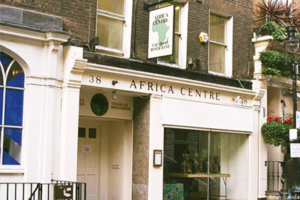
Early on I visited International PEN’s office, headquartered in Covent Garden on King Street in the Africa Centre. To get to the office at the front of the house, you had to go through the Africa Book Shop on the first floor. PEN had two rooms with several desks in the larger room with papers stacked everywhere. There was a filing cabinet and a photocopier and just enough space to squeeze between to get to the desk looking onto the street.
International PEN was kept functioning by the stalwart and efficient Elizabeth Paterson, who I don’t recall getting angry at anyone even as the work piled on and people around the world in PEN centers asked more and more of her, including the smart, demanding International Secretary Alexander Blokh. Alex flew in every month, usually from Paris, and displaced the Writers in Prison Committee’s small staff from the second office in order to conduct the business of PEN around the world. Alex was a former UNESCO official, and at that time UNESCO was one of International PEN’s major funders. When UNESCO was formed, according to Alex, it established organizations for the various arts, but when it came to literature, it recognized that PEN already existed, and so its outreach and funding funneled through PEN. Over the years PEN has grown more and more independent of UNESCO support.
Elizabeth, with her quiet intelligence and subtle humor, managed to keep International PEN running day to day while Alex developed the literary and cultural programs with the centers and the standing committees—the Translation and Linguistic Rights Committee, the Peace Committee, and the Writers in Prison Committee (WiPC). The WiPC tended to operate more autonomously with its elected chair Swedish publisher Thomas von Vegesack and before him Michael Scammell. When I arrived in London, there was also a petite gray-haired woman Kathleen von Simson, a volunteer who’d helped manage the Writers in Prison Committee work for years. PEN had recently hired a paid Coordinator Siobhan Dowd whose task was to professionalize the human rights work, and Siobhan hired researcher Mandy Garner. The two of them worked in the tiny second room. Siobhan eventually crossed the ocean to head up the Freedom to Write program at American PEN.
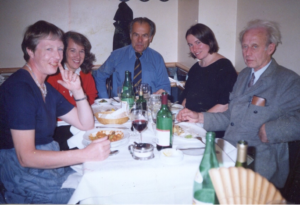
Fall 1990. Left to right: Elizabeth Paterson, Joanne Leedom-Ackerman, Per Wastberg (former PEN International President), Siobhan Dowd, Bill Barazetti
Also finding space on King Street was the Assistant Treasurer (and later International Treasurer) Bill Barazetti, who at that time was an unsung hero from World War II. It was later publicized that Bill had smuggled hundreds of Jewish children out of Prague with false identity papers he arranged. He was a wiry gray-haired former intelligence officer who’d also interrogated captured German pilots. Alex Blokh, whose pen name was Jean Blot, was an exiled Russian Jew, a lawyer and had also been active in the French Resistance during World War II, and Elizabeth had endured the bombings in London during the War. Though it was 1990 and the Berlin Wall and other barriers which had gone up after World War II were now falling, in the PEN office there was still a feeling of that post-War period, an abstemiousness and a fortitude of the dedicated amateur who knew what sacrifice was and endured no matter what. I couldn’t articulate the atmosphere at the time, but as an American born after the war, grown up in Texas and moving to London from Los Angeles, I felt the contrasts and the constraints. One small incident I remember was when a donation for a baby gift for the newly hired Sara Whyatt was being gathered. I offered £20 for the pot and was told by Elizabeth, “Oh, no, that amount would embarrass her.” The concept of anyone being embarrassed by a pooled £20 contribution silenced me. I put in £10 instead, still considered a large amount. Because I was new and an American, I tried to listen and learn, but I understood expectations and horizons were different.
A generation of my own joined the office in the persons of Jane Spender, a former editor, smart and literary who worked with Elizabeth and later Gilly Vincent, who took on the part time assignment to help with development work for the eventual International PEN Foundation. (see PEN Journey 4) Later Gilly became General Secretary of English PEN. I quickly learned to respect the differences; the American way was not the British way. I remember a fundraising event in which there must have been 20 major English writers featured and attending, and the ticket price was £25. The PEN Foundation netted perhaps £3000 that evening. In New York with that line up of writers, I am confident American PEN would have added at least one, if not two, zeros to the proceeds, but we were in London, and the event was not a glittery affair but more like a large family gathering of literary friends at someone’s home.
PEN International moved its offices in 1991 from Covent Garden to Charterhouse Buildings in Clerkenwell nearer the City of London. The new offices were on the top floor of a bonded warehouse, and I never met anyone who didn’t arrive breathless after climbing the steep four or five flights of stairs. There was no elevator, but there was an outside hoist where PEN could load supplies and mail out the window and drop or raise these to and from the ground, preferably not in the rain. Elizabeth set the door code as the beginning and ending years of World Wars I and II, an 8-digit code everyone could remember. The offices at Charterhouse Buildings were spacious compared to King Street—two large airy rooms, one for the Writers in Prison Committee and one for all the other work of PEN, a spacious entry room used as a meeting area and a smaller private office where the International Secretary could work or small meetings could be held. All the rooms were painted “magnolia”–a creamy white/yellow color. The full-time staff by then was, I think, three, along with four or five part-time staff and volunteers, including Jane Spender, Peter Day, editor of PEN International magazine, Bill Barazetti and later his daughter Kathy and occasional interns.
When Siobhan prepared to leave for the U.S., Thomas asked me to interview candidates with him for her replacement. Between interviews he explained to me his view of England in the constellation of Europe by a story of when a fog settled over the English Channel and the headline in a British paper announced: Continent Isolated. Later, when the Channel Tunnel finally connected Great Britain to France in 1994, I sent Thomas a note and a copy of the headline from a British paper: “You’ll be glad to know, Thomas: Continent No Longer Isolated, the headline read.
Thomas and I agreed on the best candidate, and PEN hired Sara Whyatt as the new Program Director of the Writers in Prison Committee. Sara came to PEN from Amnesty and set about further professionalizing WiPC’s research and advocacy work. Sara and Mandy split up the globe, with Mandy focusing on Latin America and Africa.

Across London in Chelsea, English PEN rented offices from the London Sketch Club on Dilke Street where it held weekly literary programs, a monthly formal dinner, an annual Writers Day Program honoring one writer—Arthur Miller, Graham Greene, and Larry McMurtry were three I recall—and a mid-Summer Party. The literary programs and dinners, held in the Sketchers studio and bar, featured writers such as Michael Ignatieff, Germaine Greer, Michael Holroyd, Jan Morris, Rachael Billington, A.L. Barker, Penelope Lively, Andrew Motion, A.S. Byatt, Margaret Foster, William Boyd, Margaret Drabble, Iris Murdoch, and frequently Antonia Fraser, Harold Pinter and Ronald Harwood, just to name a few.
When I moved to London and joined English PEN, the General Secretary Josephine Pullein-Thompson, a stalwart writer/member, managed the organization and kept it running with minimal staff and with active members. Author of young adult novels, Josephine wrote books about young girls and horses. When I close my eyes, I can hear her gruff voice and see her square face and think of horses. She was pragmatic and no-nonsense and what I think of as the epitome of a certain era of British resolve. She befriended me early, I think, because I was focused on a task—getting charitable status for PEN International which ultimately allowed English PEN to claim the same. It was Josephine years later who nominated me as a Vice President of International PEN.
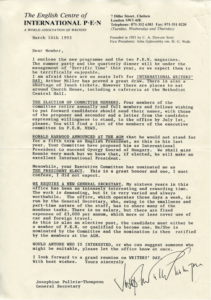
Members of English PEN were passionate about PEN’s mission to protect and speak up on behalf of writers under threat in oppressive regimes. Among activities, members, including notable British writers such as Ronald Harwood, Harold Pinter, and Antonia Fraser, who were good friends, and Moris Farhi, a Turkish/British novelist with a great beard, great girth and great heart, who later succeed me as Writers in Prison Chair, and dozens of other English PEN members held vigils, often by candlelight. They protested outside embassies of countries where writers were in prison. They got press coverage and ultimately helped secure the release of writers, particularly those in former Commonwealth countries like Malawi.
Malawian poet Jack Mapanje recalled his spirit lifting when he saw the press clippings of Harold Pinter and others protesting outside the Malawi Embassy in London on his behalf. When he was released, he resettled in England and joined English PEN.
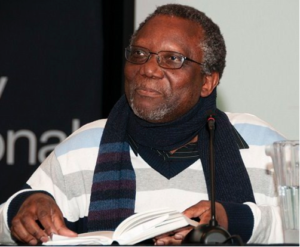
Jack Mapanje
Next Installment: Freedom and Beyond…War on the Horizon